
Experience calm and balance with yoga for stress and anxiety relief. Learn poses, breathing, and routines that naturally relax your mind and body.
Stress and anxiety affect millions of people daily. When worry, tension, or pressure mount, many seek ways to calm their mind and body. One powerful, evidence-based path is yoga for stress and anxiety relief. Through posture, breathwork, and mental focus, yoga can act as a natural balm for those inner storms. It requires no special equipment and can be tailored for any fitness level.
This article shows how yoga for stress relief works, what science says, what specific practices help most, how to begin safely, and how to make a lasting habit. You will find both technical insights and practical steps. You will feel encouraged and empowered to integrate yoga into daily life for emotional equilibrium.
If your goal is to reduce tension, quiet your mind, or find an anchor amid pressure, this piece offers substantial value. It guides you from the first tentative steps to an established practice of yoga for stress and anxiety relief that supports mental well-being in a consistent, sustainable way.
What Happens in the Body and Mind When You Use Yoga for Stress and Anxiety Relief
To see how yoga for stress and anxiety relief works, we examine changes in physiology and psychology. The mind and body are deeply connected. Through yoga, many systems shift toward balance.
- Autonomic nervous system regulation: Yoga helps activate the parasympathetic system (rest-and-digest) and temper the sympathetic (fight-or-flight). This shift lowers heart rate, reduces blood pressure, and eases muscle tension.
- Hormonal effects: Cortisol, the stress hormone, often rises under chronic tension. Studies show that regular yoga practice can reduce cortisol output and moderate the hypothalamic–pituitary–adrenal axis response.
For example, one meta-analysis suggests that cortisol measured in saliva declines with sustained yoga. - Inflammation and immune markers: Chronic stress can drive inflammation. Research shows that yoga practice corresponds with lower levels of inflammatory markers, such as CRP (C-reactive protein).
- Brain structure and connectivity: Imaging studies indicate those who practice yoga regularly may have a thicker cerebral cortex and more robust hippocampus—areas linked to memory, attention, emotional regulation.
Also, brain networks tied to emotional control show improved connectivity in yogis. - Psychological shift: Yoga cultivates present-moment focus, awareness of breath, and acceptance of internal states. Over time, this builds resilience against rumination and catastrophic thinking (common in anxiety). This mental shift supports yoga for stress and anxiety relief by reducing emotional reactivity.
- Acute effects: Even a single session can yield benefit. A scoping review found that a single 45-minute Hatha yoga session lowered stress and anxiety in many participants (healthy and clinical) in controlled studies.
This suggests yoga for stress relief can provide immediate relief, not just long-term benefit.
These mechanisms together explain why people often feel calmer, clearer, and more composed after practicing yoga.
Types of Yoga That Excel for Stress and Anxiety Relief
Not all yoga styles have equal impact on calmness and mental relaxation. Some are more suited to yoga for stress and anxiety relief. Below are styles and elements especially effective.
| Yoga Style / Element | Why It Helps with Stress & Anxiety | Suggested Use |
| Hatha Yoga | Balanced pace, focus on alignment, breath–pose integration | Excellent for beginners to intermediate |
| Vinyasa Yoga (Gentle) | Flow of movement synchronized with breath helps release tension gradually | Use slower tempo variants |
| Restorative Yoga | Long holds, bolsters, minimal effort, deep rest | Ideal on high stress days |
| Yin Yoga | Passive holds targeting connective tissues, slow pace | Good for calming nervous system |
| Trauma-Sensitive Yoga | Emphasis on safety, choice, internal pacing—sensitive to emotional states | Useful for those with trauma or high anxiety |
| Yoga Nidra | Guided meditative “yogic sleep,” deep rest without losing consciousness | Great for daily stress relief; 11-minute or 30-minute practices show hormone changes |
| Mindfulness Yoga / MBSR (Mindfulness-Based Stress Reduction) | Combines yoga posture, breath awareness, meditation | Strong evidence in stress reduction programs |
| Kaiut Yoga | Emphasizes joint mobility and neuroplastic stimuli | Emerging as a complementary method to reduce stress and emotional tension |
When structuring your yoga regime for stress and anxiety relief, you may mix a gentle flow or Hatha on most days, reserve restorative or yin on heavy stress days, and insert yoga Nidra or meditation sessions intermittently.
Easy to Start: A Simple Routine for Yoga for Stress and Anxiety Relief
Here is a beginner-friendly daily routine you can follow. Adjust time, pace, or intensity to suit your body and circumstances.
Routine (approx. 20–30 minutes):
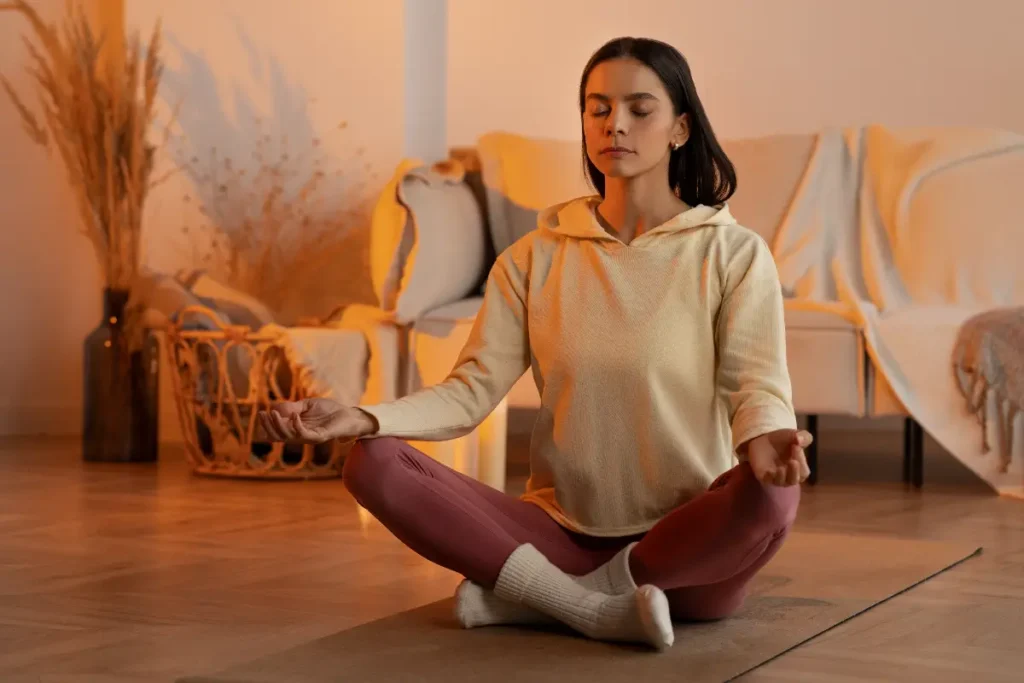
- Seated breathing (3 minutes)
Sit comfortably. Use abdominal (diaphragmatic) inhale for a count of 4, exhale for 6. Continue this ratio.
This activates the parasympathetic system. - Gentle warm-ups (5 minutes)
Movements such as neck rolls, shoulder rotations, cat/cow (Marjaryasana–Bitilasana), gentle spinal twists. - Main asanas (10–15 minutes)
- Downward Dog (Adho Mukha Svanasana) — helps lengthen spine, release tension
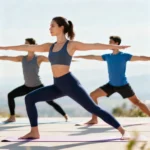
- Warrior II (Virabhadrasana II) — builds grounded strength
- Tree Pose (Vrksasana) — enhances balance, focus
- Standing Forward Fold (Uttanasana) — soothes nervous system
- Bridge Pose (Setu Bandha Sarvangasana) — opens chest, moderates’ breath
- Restorative posture or supported pose (3–5 minutes)
e.g. Legs Up the Wall (Viparita Karani) or Reclined Bound Angle (Supta Baddha Konasana) - Yoga Nidra / guided relaxation (5 minutes)
Use recorded audio to guide body awareness, breath, intention. Even short durations show benefit.
Tips for success:
- Begin with at least 3–4 days per week, then expand toward daily practice.
- Focus on the exhale, extending it slightly longer than inhale.
- Use props — blocks, cushions, blankets — to make poses more comfortable.
- Don’t push into pain. Let ease lead.
- Keep a log of how you feel before & after practice (e.g. stress scale 0–10).
By following this simple routine, you engage multiple dimensions of yoga for stress and anxiety relief: breath, posture, rest, introspection.
Deepening the Practice: Intermediate Strategies
Once you feel comfortable with a basic routine, you can enhance your practice to yield greater resilience and stress management. Here are strategies to deepen the effect of yoga for stress and anxiety relief.
- Lengthen practice duration progressively
Move from 20 to 45 minutes or more as your stamina builds. - Integrate standing and inversion poses
Poses like headstand (supported), shoulder stand, and handstand (modified) can boost energy and calm the mind. Use them cautiously and with guidance. - Explore longer holds (yin or restorative days)
Hold passive postures for 2–5 minutes or more. That deep stretch invites release at a tissue and nervous level. - Add pranayama techniques
- Nadi Shodhana (alternate nostril breathing)
- Ujjayi breath (ocean sound breath)
- 4–7–8 breathing
These practices heighten breath control and calm the nervous system.
- Incorporate mantra, chanting, or silent repetition
Repetition of a phrase or sound (e.g. “Om”, “So Hum”) can steady the wandering mind. - Mindful transitions
Move slowly and with awareness between poses. The spaces between matter. - Use variation and creativity
Shift your sequence now and then. That fresh novelty can reduce mental monotony and keep engagement high. - Study or attend workshops
Learning alignment, anatomy, or philosophy can deepen your connection to the practice and make it more meaningful.
By applying these intermediate strategies, you amplify yoga for stress and anxiety relief beyond a simple routine and integrate it into your lifestyle.
Evidence and Recent Studies on Yoga for Stress Relief
To maintain credibility, here are some recent scientific findings affirming yoga for stress relief and yoga for stress and anxiety relief.
- A systematic review highlighted various stress biomarkers (like heart rate variability, cortisol) and confirmed that yoga practices reduce those markers substantially.
- The single session scoping review reported that one 45-minute Hatha session can lower anxiety and stress in both clinical and non-clinical populations.
- A 2024 article in summarized recent trials showing that yoga reduced perceived stress and improved well-being metrics.
- The Frontiers public health review emphasized yoga’s role in reducing physiological stress, improving sleep and resilience, and supporting long-term mental health.
- A bibliometric study in 2025 confirmed rising interest and evidence linking yoga with reduced stress, enhanced cognitive function, and emotional balance.
- A new controlled trial on yoga Nidra showed that even an 11-minute practice reduced stress, anxiety, depression and adjusted cortisol rhythms over time.
- A study on non-clinical adult populations confirmed that yoga interventions lower stress even in everyday settings.
Together, these studies validate that yoga for stress and anxiety relief is not just anecdotal or spiritual — it has measurable effects.
Benefits Beyond Stress Relief: What You Gain
When you practice yoga for stress and anxiety relief, you also access a range of auxiliary benefits that enrich life.
- Improved mood and resilience: As baseline stress drops, you feel more stable emotionally.
- Enhanced sleep quality: Calm mind plus regulated autonomic system support deeper, restorative sleep.
- Better focus and cognitive function: Memory, clarity and task switching improve as mental noise lessens.
- Strengthened flexibility, strength, balance: The body grows more capable physically.
- Reduced chronic pain or tension: Many people report less back pain, tension headaches, stiff neck.
- Lower risk of stress-related illness: Hypertension, cardiovascular strain, immune suppression—all these risks diminish.
- Supportive habit formation and discipline: The practice reinforces consistency, patience and daily ritual.
So, yoga for stress relief offers holistic gains, not just momentary calm.
Overcoming Barriers and Common Challenges
Even well-intentioned yogis face obstacles. Here’s how to overcome common challenges when practicing yoga for stress and anxiety relief.
- Time constraints
- Use micro sessions (5–10 minutes) when full time is unavailable
- Practice breathing exercises or yoga Nidra even at a desk or before sleep
- Physical limitations or injury
- Use props (blocks, straps, bolsters)
- Modify or avoid poses that aggravate
- Work with an instructor trained in therapeutic or trauma-sensitive yoga
- Mental restlessness / wandering mind
- Focus on breath, not outcome
- Allow distraction, gently return attention
- Use guided audio or videos to support concentration
- Plateau / lack of motivation
- Vary your practice style (yin, restorative, flow)
- Join a class or community
- Track progress emotionally (less stress) rather than just physical
- Doubt or skepticism
- Begin modestly and track effects (journal your stress score before/after)
- Read scientific articles (like the ones cited above)
- Engage in a short-committed trial (e.g. 4 weeks); let personal experience guide you
- Emotional resistance revealing deeper patterns
- Some suppressed emotions may surface. Use journaling, therapy, or somatic support where needed
- Respect that yoga is a complementary tool, not a replacement for mental health therapy when appropriate
By acknowledging these challenges and using adaptive strategies, your path to yoga for stress and anxiety relief becomes sustainable.
How to Make Yoga for Stress and Anxiety Relief a Habit
To reap full benefit, you must turn occasional practice into a consistent habit. Here are strategies to embed yoga for stress and anxiety relief in your life.
- Anchor to an existing habit
E.g. after brushing your teeth, do 5 minutes of breathing then some asanas. - Set reminders or alarms
Use phone or calendar prompts to nudge short sessions. - Design a dedicated space
A quiet corner with mat, props, a candle or plant — that visual cue supports regularity. - Use accountability
Practice with a friend or join online/in-person classes. - Track your progress
Maintain a journal or app log: date, duration, stress score pre/post, notes. - Micro-commitment first
Start with low minimums (3 minutes, 2 days per week). Build gradually to avoid burnout or guilt. - Reward consistency
Acknowledge weeks of sustained practice. Small rewards (a tea break, song, meditation) help. - Scale with life changes
Adjust your routine during travel, illness, or busy periods. Flexibility prevents abandonment.
Through these methods, yoga for stress and anxiety relief becomes not an occasional activity but a supportive companion in your daily rhythm.
Sample Monthly Plan for Integrating Yoga for Stress Relief
Below is a sample 4-week plan that progressively builds skill, consistency, and depth in your yoga for stress and anxiety relief journey.
| Week | Focus | Approx. Frequency | Duration | Notes |
| Week 1 | Essentials & Habit Building | 3 days | 20 min | Seated breathing, gentle warmups, 3 basic poses, short yoga Nidra |
| Week 2 | Stability & Flow | 4 days | 25 min | Add standing poses, gentle flow, deepen blocks and transitions |
| Week 3 | Rest & Mindful Recovery | 5 days | 30 min | Introduce restorative or yin day, longer holds, varied breathwork |
| Week 4 | Integration & Expansion | 5–6 days | 35-40 min | Add pranayama, creative sequence, occasional inversion or balance, longer yoga Nidra |
You may then repeat cycles, modify duration, or layer new elements. Use your log to adjust based on results: if anxiety fell faster, push a bit; if stress resurged, lean on restful days.
Real-Life Stories and Testimonials (Illustrative)
Hearing real voices can make this more alive. Below are composite/representative stories (not real names) based on common trajectories.
- “Samantha, a busy manager in London”
Samantha felt overwhelmed by work deadlines. She started with 10 minutes of seated breathing and a forward fold each night. Within two weeks of yoga for stress relief, her mind quieted more easily and she slept with fewer awakenings. After a month, she added a 5-minute yoga Nidra guided practice and noticed her morning anxiety had eased. - “Rajiv, software engineer in Mumbai”
Rajiv had chronic shoulder tension and worry about performance. He joined a gentle Hatha class and committed to three sessions weekly. After six weeks, his perceived stress score dropped by nearly half, and his muscles relaxed. The habit stuck as he made his rooftop a mini studio. - “Elena, university student in Madrid”
Elena battled exam anxiety and sleepless nights. She discovered yoga for stress and anxiety relief via an online 15-minute flow routine before study breaks. She also used yoga Nidra nightly. Her panic attacks decreased, concentration improved, and she reported more emotional stability.
These narratives mirror what many users experience, bridging scientific evidence to human effect.
Safety, Precautions and When to Seek Professional Help
Yoga is generally safe, but precautions matter, especially when using yoga for stress and anxiety relief as a self-help tool.
- Consult a medical provider if pregnant, recovering from injury, or having chronic conditions (e.g. hypertension, glaucoma, heart issues).
- Avoid poses that strain joints or compress spine if you have herniated discs or arthritis.
- Move slowly into inversions or head standing; use support or skip entirely if uncertain.
- If emotional distress intensifies or unresolved trauma arises, combine yoga with mental health therapy.
- Respect your limits; rest is also part of practice.
- Be patient: results may not emerge overnight.
Recognize that yoga is a companion, not a replacement, for clinical care when needed.
Final Words
Embarking on yoga for stress and anxiety relief is a meaningful choice. This path offers not only momentary calm but a shift in how you relate to pressure, thought, and tension. With consistent effort, your nervous system aligns toward balance; your mind becomes steadier and more resilient.
Begin with simple breathing practices and gentle movement. Grow slowly. Use rest, support, and introspection to guide you. Let yoga for stress relief evolve naturally into a lifestyle that protects your mental space. In time, it will feel less like “exercise” and more like respiration — necessary, sustaining, and restorative.
You now carry both the why and the how. Let your mat become a refuge. Let each session reaffirm your capacity to meet life’s demands, calmer, clearer, stronger.
Frequently Asked Questions
Q1: Can I practice yoga for stress and anxiety relief even if I am stiff or inflexible?
Yes. Many beneficial poses and breathing techniques are accessible to all bodies. Use props, modify ranges, and allow gradual progress. Even seated breathing or yoga Nidra offers benefit.
Q2: How soon will I see reduction in stress with yoga for stress relief?
Some people feel a change after the very first session (e.g. lower tension, calmer breath). In studies, a single 45-minute Hatha class reduced anxiety and stress markers. But lasting shifts usually arise after several weeks of consistent practice.
Q3: Do I need a teacher or class to begin practicing yoga for stress and anxiety relief?
Not necessarily. You can start at home with guided audio or videos. But for proper alignment, personalized modifications, and confidence, working with a qualified instructor helps, especially for therapeutic or intermediate yoga.
Q4: Can I combine yoga for stress and anxiety relief with meditation or other forms of exercise?
Absolutely. Combining yoga with meditation enhances mental calm. Other physical activities (walking, swimming) complement yoga. Just ensure not to overdo — generous rest days support recovery.
Q5: Is yoga Nidra more effective than asana for stress relief?
They serve complementary roles. Asana (movement) relieves muscular tension and engages body awareness. Yoga Nidra provides deep rest and psychological integration. Studies show even short Nidra practices influence cortisol rhythms. Use both in balance.
Q6: Does yoga for stress and anxiety relief suit people with clinical anxiety or depression?
Yes, as an adjunct to therapy or care. Many trials include participants with anxiety or mental health conditions. But yoga is not a substitute for psychiatric treatment when required. Always consult professionals for severe symptoms.